

 IMS - Modular Synchronization
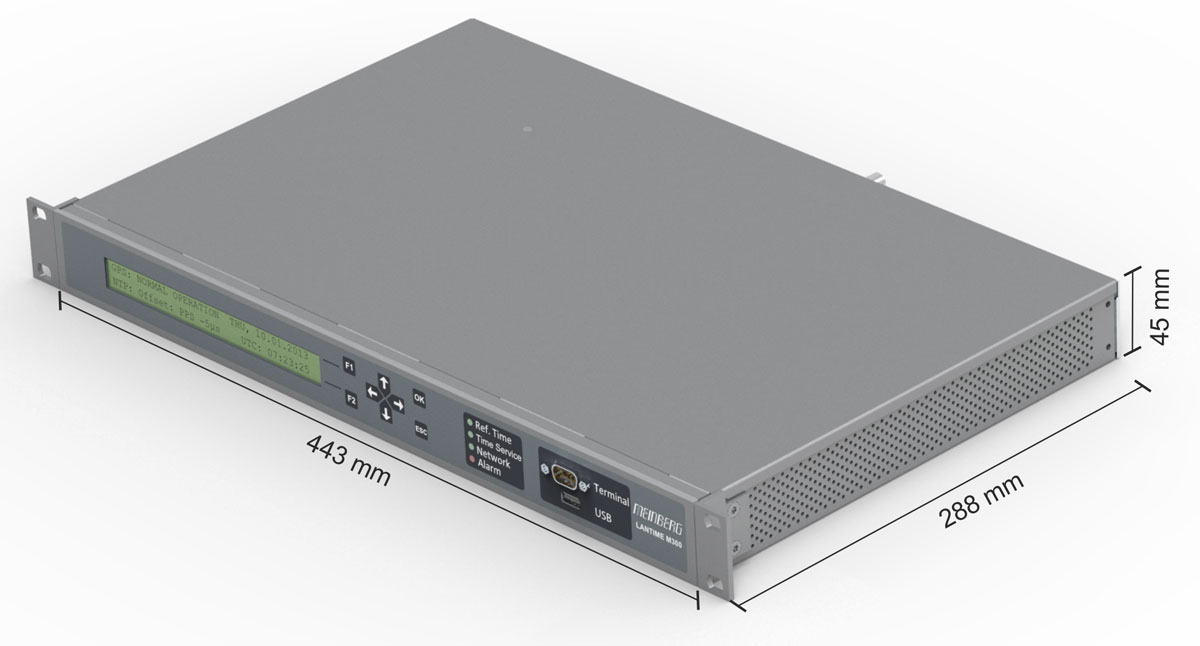
LANTIME M320: NTP Server in 1U Case for Server Rackmount

Key Features


-
Selectable Reference Time Sources:
- GPS: Satellite receiver for the Global Positioning System
- GNS: Combined GPS/GLONASS/Galileo/BeiDou satellite receiver, can also be used for mobile applications
- GNS-UC: GPS and Galileo Satellite Receiver with Up-Converter for Meinberg GPS Antenna/Converter
- GNM: GPS/GLONASS/Galileo/BeiDou - Multi Band satellite receiver (L1/L2 frequency band) for simultaneous reception of all satellite systems
- PZF: DCF77 correlation receiver for middle europe
- MSF: Long wave receiver for Great Britain
- TCR: Time code receiver for IRIG A/B, AFNOR or IEEE1344 codes
- MRS: (GPS, PPS, 10MHz, NTP): Multi Reference Source - several reference sources, adjustable following priority of signal
- RDT: (external PPS or NTP): Time Server without internal receiver module
- Synchronizes NTP-compatible clients with support for NTP, SNTP, and NTS - Network Time Security
- Web interface that is both powerful and easy to use
- Backlit LCD panel and function keys for local configuration
- Frequency signals and industry-specific sync signals via additional optional outputs
- USB port for installation of firmware updates, backup/restore of configuration and log files, and disabling/enabling access to front panel controls
- Command line interface for advanced power users with absolute control over every facet of the server's functionality
- Comprehensive networking support, including full HTTPS encryption for Web Interface and REST API with TLS certificate management
- Support for syslog, SNMP, and SMTP for comprehensive event logging, network integration, and notification functionality
- GNS models include Multi-GNSS antenna for reception of GPS, Galileo, BeiDou, and GLONASS signals
- GPS and GNS-UC models include Meinberg IF antenna of reception of GPS signals and, with GNS-UC models, also Galileo signals
-
Previous Models - LANTIME M320:
LANTIME M300 :: NTP Server in 1U Case for Server Rackmount
LANTIME/GPS :: NTP Time Server with integrated GPS radio clock
LANTIME/TCR :: NTP Time Server with integrated IRIG timecode reader
LANTIME/NDT :: NTP Time Server with integrated OCXO
LANTIME/PZF :: NTP Time Server with integrated DCF77 radio clock
LANTIME/RDT :: NTP Time Server
Product Description
A large display shows the state of the NTP subsystem.
The configuration of the system can be done by using a standard web browser to access the extensive but straightforward html interface. Alternatively a text based and menu driven setup utility can be started from the shell prompt after logging into the unit via Telnet or SSH.
Because of its modular system architecture it is possible to equip this LANTIME time server with up to six ethernet ports, even fiber optic network ports and one or three Gigabit Ethernet ports are available as an option.
Oscillator Options
The LANTIME M320 comes standard with a "TCXO" (Temperature Controlled Crystal Oscillator) which provides excellent holdover performance in case your time server loses synchronization with its upstream reference for some reason. On request the LANTIME M320 can also be delivered with a more powerful holdover solution (OCXO LQ/SQ/MQ/HQ/DHQ) (see oscillator overview).
MRS - Multi Reference Source capable
In addition, this NTP time server can also be synchronized via other signal sources as GNSS or NTP. PPS, 10 MHz, IRIG Time Codes are also available for our M320/MRS model.
The MRS version comes with a high quality OXCO and is designed to act as a reliable time source in applications where no antenna can be installed. The internal OCXO-HQ can be fully disciplined by utilizing one or more remote NTP time servers. Thus, a LANTIME MRS time server can be run in fully independent mode in environments where no source of time is available.
Configuration and Monitoring
The configuration of the system can be managed by using a standard web browser for accessing the extensive but straightforward HTML web interface. Alternatively a text based and menu driven setup utility can be started from the shell prompt after logging into the unit via Telnet or SSH.
Characteristics
| Status Indicators | Four bicolor LEDs indicating: - Reference time status - Time service status - Network link status - Alarm states |
| Display | LC-Display, 2 x 40 Characters, with Backlight |
| Control Elements | Eight push buttons to set up basic network parameters and to change receiver settings |
| Frequency Outputs | 10 MHz via female BNC connector, TTL into 50 Ohm Accuracy depends on oscillator (standard: TCXO), look at oscillator list |
| Pulse Outputs | Pulse Per Second (PPS), TTL level, pulse width: 200 ms |
| Accuracy of Pulse Outputs | Depends on oscillator option: < ±100ns (TCXO, OCXO LQ) < ±50ns (OCXO SQ, OCXO MQ, OCXO HQ, OCXO DHQ) |
| Interface | Two independent serial RS-232 interfaces, menu configurable (in case of RDT models without internal receiver - the serial interfaces will be used as reference input). |
| Optional Output Signals |
Additional Output Options::
This LANTIME NTP server comes with many additional outputs options: PPS, 10MHz, programmable pulse outputs (PPS, PPM, PPH, DCF_MARK ...), IRIG modulated and unmodulated time code, T1 / E1 telecom signals, Frequency Synthesizer - to name just a few. Contact us for your specific device configuration. |
| Serial Time String Output |
COM 0:
Baudrate: 300, 600, 1200, 2400, 4800, 9600, 19200 Baud Data Format: 8E1, 8E2, 8N1, 8N2, 8O1, 7E1, 7E2, 7N2, 7O1, 7O2 Time Telegram: Meinberg Standard Time String , SAT, NMEA RMC, Uni Erlangen (NTP), COMPUTIME, Sysplex, Capture String, SPA, RACAL, Meinberg GPS, NMEA GGA, NMEA RMC GGA, NMEA ZDA, ION, 6021 or IRIG-J |
| Relay Outputs |
Error Relay
|
| Network Interface |
Standard: 2 x 10/100 MBit with RJ45 connector
Available Options:
|
| Universal Serial Bus (USB) Ports | 1x USB port on front panel for: - installing firmware upgrades - performing backups and restoration of configuration files - copying security keys - locking & unlocking front buttons |
| Operating Voltage |
Standard:
UN = 100-240 V AC (50/60 Hz) / 100-200 V DC Umax = 90-265 V AC / 90-250 V DC Available DC variants: UN = 100-200 V DC, 24 V DC and 24-48 V DC Umax = 90-250 V DC, 10-36 V DC and 20-60 V DC Redundant power supply combinations available |
| Form Factor | 19 inch multipac metal case 1U/84HE |
| CPU |
|
| Operating System of the SBC | Custom LANTIME OS based on Linux 4.x LTS Kernel. |
| Network Protocols OSI Layer 4 (Transport Layer) | TCP, UDP |
| Network Protocols Authentication | A LANTIME NTP server supports Radius, TACACS+ and LDAP(S) as external authentication methods.
|
| Network Protocols OSI Layer 7 (Application Layer) | Telnet, FTP, SSH (including SFTP, SCP), HTTP, HTTPS, syslog, SNMP |
| Internet Protocol (IP) | IPv4, IPv6 |
| Network Autoconfiguration Support | IPv4: Dynamic Host Configuration Protocol - DHCP (RFC 2131) IPv6: Dynamic Host Configuration Protocol - DHCPv6 (RFC 3315) and Autoconfiguration Networking - AUTOCONF (RFC 2462) |
| Network Time Protocol (NTP) | NTP v2 (RFC 1119), NTP v3 (RFC 1305), NTP v4 (RFC 5905)
SNTP v3 (RFC 1769), SNTP v4 (RFC 4330) MD5 / SHA-1 Authentication and Autokey Key Management |
| Parallel Redundancy Protocol (PRP) | PRP (IEC 62439-3) |
| Time Protocol (TIME) | Time Protocol (RFC 868) |
| IEC 61850 | Synchronization of IEC 61850-compliant devices using SNTP |
| Hypertext Transfer Protocol Secure (HTTPS) | HTTP(S) for web interface and REST API access |
| Secure Shell (SSH) | SSH v1.3, SSH v1.5, SSH v2 (OpenSSH) |
| Telnet | Telnet (RFC 854-RFC 861) |
| Simple Network Management Protocol (SNMP) | SNMPv1 (RFC 1157), SNMPv2c (RFC 1901-1908), SNMP v3 (RFC 3411-3418) |
| Supported Temperature | Operational: 0 - 50 °C (32 - 122 °F)
Storage: -20 - 70 °C (-4 - 158 °F) |
| Supported Humidity | Max. 85 % (non-condensing) at 40 °C |
| Contents of Shipment | Included in delivery is a Meinberg outdoor antenna incl. mounting kit, pre-assembled antenna cable (except TCR and RDT models). |
| Technical Support | Meinberg offers free lifetime technical support via telephone or e-mail. |
| Warranty | Three-year warranty |
| Firmware Updates | Firmware is field-upgradeable, updates can be installed directly from the unit or via a remote network connection. Software updates are provided free of charge for the lifetime of your Meinberg product. |
| RoHS Status of Product | This product is fully RoHS-compliant. |
| WEEE Status of Product | This product is handled as a B2B (Business to Business) category product. To ensure that the product is disposed of in a WEEE-compliant fashion, it can be returned to the manufacturer. Any transportation expenses for returning this product (at end-of-life) must be covered by the end user, while Meinberg will bear the costs for the waste disposal itself. |
| Additional Information | Additional information about the Meinberg LANTIME family of NTP time servers and other LANTIME models can be found on the LANTIME overview page . |
Downloads
Short Info Sheet
Manuals
- Handbuch (deutsch) ltos_7-08.pdf als PDF: 25525KB - Stand: 13.Feb.2024
- Handbuch (deutsch) setup-guide_d.pdf als PDF: 879KB - Stand: 12.Jul.2023
- Manual (english) ltos_7-08.pdf as PDF: 23916KB - Rev.: 2024-Feb-13
- Manual (english) setup-guide_d.pdf as PDF: 879KB - Rev.: 2023-Jul-12
LTOS - CLI and REST API Reference
- For drivers, SDKs, tools and utilities, please check our Download Section