


 Product Information
DCF77 longwave time signal
DCF77 Abstract
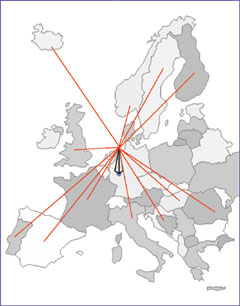
Meinberg DCF77 radio clocks receive the DCF77 time signal from the low frequency transmitter located in Mainflingen near Frankfurt, Germany. The LF transmitter disseminates the Legal Time of the Federal Republic of Germany which is either the Central European Time, CET (in German: Mitteleuropäische Zeit, MEZ) or the Central European Summer Time, CEST (in German: Mitteleuropäische Sommerzeit, MESZ). The DCF77 signal can be received in many parts of Europe.
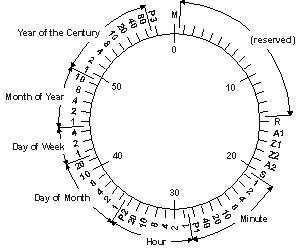
The DCF77 frequency and signal is derived from the atomic clocks of the Physikalisch-Technische Bundesanstalt (PTB) in Braunschweig, Germany, the national institute for science and technology and the highest technical authority of the Federal Republic of Germany for the field of metrology and physical safety engineering. The signal transmission is controlled by the PTB's Department of Length and Time. The coded time message includes the current time of day, date of month and day of week and is transmitted once every minute in coded one-second pulses.
At the beginning of every second the, amplitude of the precise 77.5 kHz carrier frequency is reduced by 75% for a period of 0.1 or 0.2 sec. The length of these time marks represents a binary coding scheme using the short time mark for logical zeroes and the long time mark for logical ones. Data representing the current date and time, as well as some parity bits and status bits are encoded in the time marks from the 15th to the 58th second of every minute. The absence of any time mark at the 59th second signals that a new minute will begin with the next time mark.
Meinberg DCF77 Systems
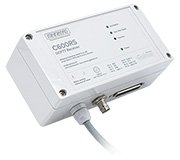
DCF77 radio clock with serial RS232 interface
Read More...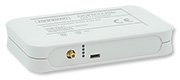
DCF77 Radio-Controlled Clock for Universal Serial Bus (USB) Interface
Read More...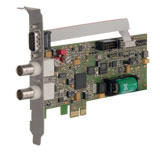
Low Profile DCF77 Clock (PCI Express)
Read More...In order to increase the accuracy of the demodulated time marks, the carrier of DCF77 is also modulated with a pseudo-random phase noise. The pseudo-random sequence has a length of 512 bits, and is transmitted in the interval between the AM marks. Due to the pseudo-random characteristic of the sequence, the mean deviation of the carrier phase is zero. The phase modulated carrier can be received with a larger bandwidth receiver. Correlation algorithms used with satellite transmission techniques allow PZF receivers to determine the correct time with an accuracy of microseconds, which is far superior to the accuracy achieved by standard AM receivers.
DCF77 Coding Scheme
|
|
||||||||||||||
